
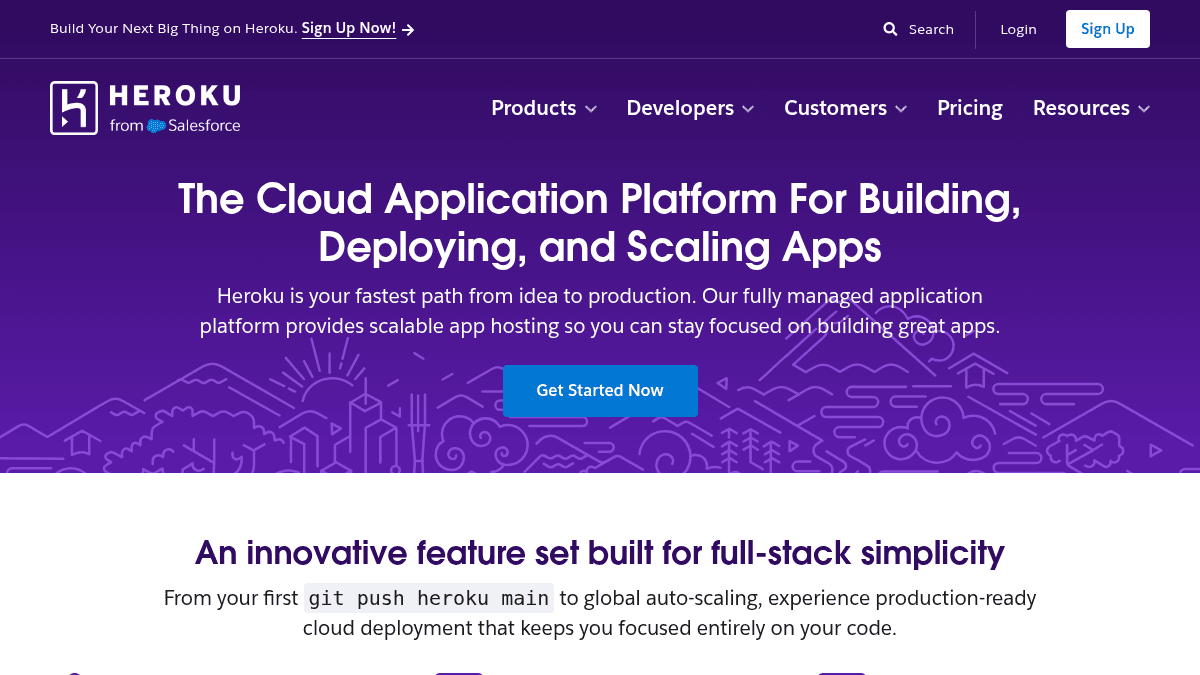
About Heroku
Overview Heroku is a fully managed cloud application platform (PaaS) that lets developers build, deploy, and scale apps without managing infrastructure. It is built on a managed container system called dynos that handle code, dependencies, and scaling automatically. The platform supports multiple programming languages including Python, .NET, Java, Node.js, Go, PHP, Ruby, Scala, and Clojure. Heroku differentiates from raw cloud providers like AWS or GCP by abstracting away server management, networking, and operations so developers can focus on writing code. Key Benefits Fully managed app hosting eliminates infrastructure management so teams focus on building applications. Dynos provide lightweight, isolated containers that handle code, dependencies, and scaling automatically. Polyglot platform supports nine programming languages including Python, Java, Node.js, Go, Ruby, and more. Managed data services including Heroku Postgres, Key-Value Store, and Apache Kafka reduce operational overhead. Heroku AI offers managed inference and agents with access to LLMs, embedding models, and image generation models. Enterprise features include Private Spaces, Heroku Shield, and Heroku Connect for Salesforce data sync. How It Works You push your code to Heroku via Git, and the platform automatically builds and runs your application inside lightweight isolated containers called dynos. You scale your app by adjusting the number and type of dynos through the dashboard or CLI, and add managed data services like Heroku Postgres or Key-Value Store with a single command. Heroku handles load balancing, logging, and runtime management so your app stays online without manual intervention. Use Cases Startup founders deploy MVP applications rapidly using Git-based workflows and managed dynos. Full-stack developers at agencies build and host client projects with polyglot language support including Python, Node.js, and Ruby. Enterprise engineering teams run critical applications in Heroku Private Spaces with enhanced compliance and security controls. Data engineers use Apache Kafka on Heroku for real-time streaming data processing and event-driven architectures. AI application developers integrate LLMs, embedding models, and image generation via Heroku Managed Inference without managing AI infrastructure. E-commerce companies like TAO Drive use Heroku AppLink for secure Salesforce integration and scalable Node.js storefronts. Why Choose This Product Heroku is best suited for developers and teams who want to ship applications quickly without managing servers, containers, or infrastructure. The platform supports everything from hobby projects on free dynos to enterprise-grade applications with Private Spaces, Shield compliance, and Signature support. Limitations include that advanced enterprise features like Heroku Shield and Heroku Connect Enterprise Edition are only available to Heroku Enterprise customers.
Heroku Pros & Cons
- Fully managed platform — no server management needed
- Supports 9 programming languages
- Managed Postgres, Kafka, and Key-Value Store
- Free tier available (Eco dynos)
- Git-based deployment workflow
- Free dynos sleep after 30 minutes of inactivity
- Enterprise features require Enterprise plan
- Advanced support requires paid Success plans
Key Features
Dyno Containers
Lightweight, isolated containers that handle code, dependencies, and scaling automatically.
Heroku Postgres
Fully managed PostgreSQL database service optimized for developers with trusted security and scalability.
Key-Value Store
Managed open-source data store offering flexibility and efficiency for various application needs.
Apache Kafka
Fully managed streaming data service enabling real-time data processing and event-driven architectures.
Managed AI Inference
Access to curated LLMs, embedding models for RAG, and diffusion models for image generation without managing AI infrastructure.
Heroku Connect
Seamlessly sync data between Heroku Postgres and Salesforce with Demo, Enterprise, and Shield Editions.
Private Spaces
Network-isolated environments for enterprise applications with enhanced compliance and security controls.
Heroku Shield
Compliance-focused features for organizations running critical applications with strict regulatory requirements.
Elements Marketplace
Ecosystem of add-ons, integrations, and buildpacks to accelerate app development.
Heroku Pricing
View full pricing →- Access to Dev Center and documentation
- Basic support via Help Portal
- Community access via Trailblazer communities
- Web dyno with sleep after 30 min inactivity
- 512 MB RAM per dyno
- Basic monitoring and logging
- Web dyno always-on, no sleep
- 1 GB RAM per dyno
- Advanced metrics and log retention
- Automated certificate management
- Private Spaces for network isolation
- Heroku Shield compliance features
- Heroku Connect Enterprise Edition
- Signature support with faster response times
| Feature | Eco Free/mo | Basic $7/mo | Production $25/mo | Enterprise Custom |
|---|---|---|---|---|
| Access to Dev Center and documentation | ||||
| Basic support via Help Portal | ||||
| Community access via Trailblazer communities | ||||
| Web dyno with sleep after 30 min inactivity | ||||
| 512 MB RAM per dyno | ||||
| Basic monitoring and logging | ||||
| Web dyno always-on, no sleep | ||||
| 1 GB RAM per dyno | ||||
| Advanced metrics and log retention | ||||
| Automated certificate management | ||||
| Private Spaces for network isolation | ||||
| Heroku Shield compliance features | ||||
| Heroku Connect Enterprise Edition | ||||
| Signature support with faster response times |
Pricing extracted from the product website and may change. Check the source for current details.
Frequently asked questions about Heroku
What are Heroku dynos?
Dynos are lightweight, isolated containers that handle your code, dependencies, and scaling. They are the building blocks that power any Heroku app, from simple to sophisticated.
Does Heroku have a free tier?
Yes, Heroku offers Eco dynos at $0 per month, providing a free entry point for developers to build and test applications.
What languages does Heroku support?
Heroku supports Python, .NET, Java, Node.js, Go, PHP, Ruby, Scala, and Clojure.
What is Heroku Connect?
Heroku Connect seamlessly syncs data between Heroku Postgres and Salesforce. It starts free with the Demo Edition, with Enterprise and Shield Editions available for Heroku Enterprise customers.
Is Heroku free?
Heroku offers a free plan with optional paid upgrades. See the pricing section for what's included in each tier.
How much does Heroku cost?
Heroku offers the following plans: Eco, Basic, Production, Enterprise. See the pricing section for what's included in each tier and any per-seat or usage-based costs.