
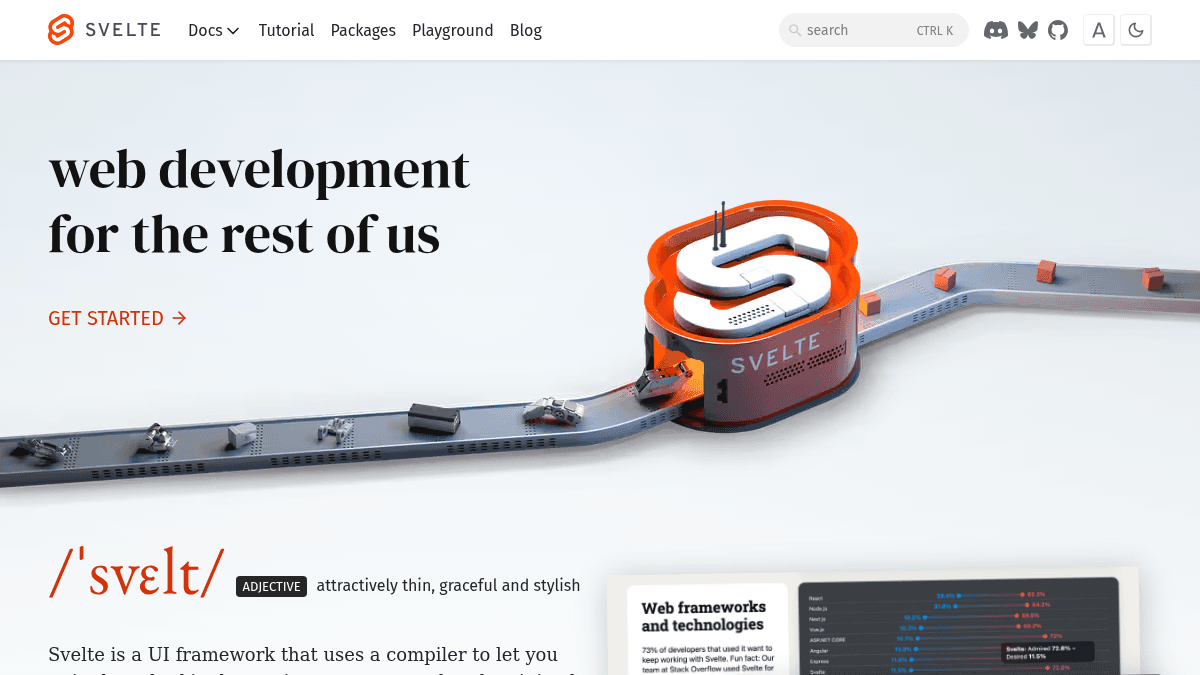
About Svelte
Overview Svelte is a UI framework that uses a compiler to let you write concise components using HTML, CSS, and JavaScript. It shifts work from the browser to a compile step, producing minimal JavaScript that runs efficiently on the client. The framework is open source under the MIT license and backed by Vercel along with countless individual donors. It targets developers who want a simpler, more performant alternative to runtime-heavy frameworks like React or Vue. Key Benefits Svelte uses a compiler to produce code that does minimal work in the browser, reducing runtime overhead. Components are written in standard HTML, CSS, and JavaScript — no framework-specific syntax to learn. Developers consistently rank Svelte as the UI framework they are most excited about using. The framework is free and open source software released under the MIT license. Backed by Vercel and supported by a large community of full-time and part-time maintainers. How It Works You write your UI components as plain HTML, CSS, and JavaScript files. Svelte's compiler then transforms these components into highly optimized imperative code during a build step. The resulting bundle loads in the browser with minimal JavaScript, so your app stays fast and lightweight. Use Cases Frontend developers building high-performance web apps that need small bundle sizes. Developers migrating from React or Vue who want to reduce client-side JavaScript overhead. Open source contributors looking to join a community with an active Discord and global events organized by Svelte Society. Teams deploying through Vercel or similar platforms, since Svelte has direct backing from Vercel. Hobbyists and learners who want a framework that relies on standard web languages rather than proprietary APIs. Why Choose This Product Svelte is best suited for developers who value small bundles, standard web technologies, and a compiler-based approach to UI frameworks. It is not a runtime library, so teams accustomed to virtual-DOM paradigms (like React) will need to adapt to its compile-first model.
Svelte Pros & Cons
- Compiler-based approach reduces client-side JavaScript
- Uses only standard HTML, CSS, and JavaScript
- Free and open source under MIT license
- Backed by Vercel with active maintainer community
- Interactive tutorial and in-browser playground available
Key Features
Compiler-based framework
Svelte compiles components during build time, producing optimized imperative code that does minimal work in the browser.
Standard web languages
Components are written in standard HTML, CSS, and JavaScript, removing the need for framework-specific template languages.
Small bundle size
The compiled output uses minimal JavaScript, resulting in smaller bundles and faster page loads.
Open source MIT license
Svelte is released under the MIT license, free to use, modify, and distribute.
Backed by Vercel
Backed by Vercel with financial and infrastructure support alongside a large maintainer community.
Active community
A sister organization, Svelte Society, runs events globally and maintains an active Discord server for community discussion.
SvelteKit framework
SvelteKit extends Svelte with routing, server-side rendering, and static site generation capabilities.
Interactive tutorial
An interactive tutorial is available to help developers learn Svelte components and concepts step by step.
In-browser playground
An integrated package playground lets you experiment with Svelte components directly in the browser.
High runtime performance
The compiler outputs highly efficient DOM manipulation code, reducing runtime overhead compared to traditional virtual-DOM libraries.
Svelte Pricing
- Compiler-based UI framework
- Write components in HTML, CSS, and JavaScript
- Minimal runtime JavaScript output
- MIT licensed — free to use, modify, and distribute
Pricing extracted from the product website and may change. Check the source for current details.