
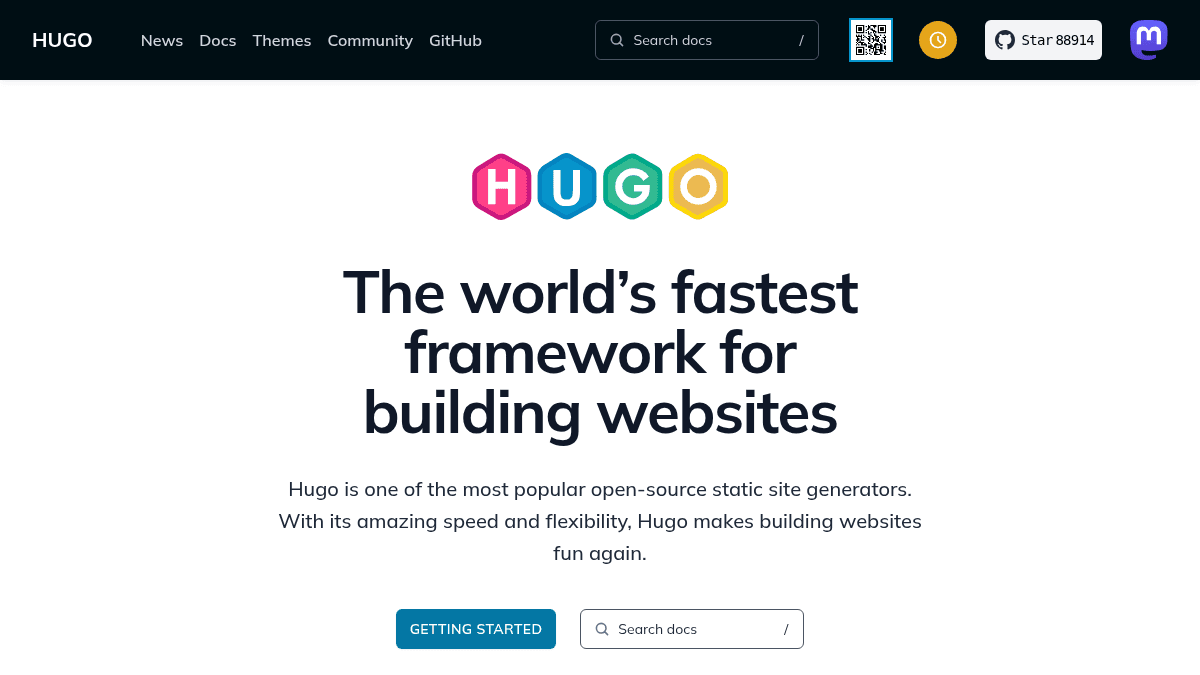
About Hugo
Overview Hugo is an open-source static site generator written in Go, optimized for speed and designed for flexibility. It renders large websites in seconds, often less, using an advanced templating system and fast asset pipelines. Unlike traditional content management systems or JavaScript-based site generators, Hugo compiles static HTML pages from Markdown content with no database or runtime dependencies. It is built for developers, content teams, and organizations that need fast, reliable websites. Key Benefits Renders a large site in seconds, often less, using Go-based performance optimizations. Open source and free to use under the Apache 2.0 License. 88,914 stars on GitHub with a large, active community and frequent releases. Supports multilingual content and a powerful taxonomy system for organizing content. Includes image processing, JavaScript bundling, Sass processing, and TailwindCSS support. Embedded web server provides instant preview of content, structure, and presentation changes during development. How It Works You write content in Markdown, organize it with Hugo's taxonomy system, and select a theme from the community library. Hugo compiles the content into static HTML pages using its Go-based engine, rendering even large sites in seconds. During development, you use Hugo's embedded web server to preview changes instantly before deploying the static output to any hosting provider. Use Cases Documentation teams use Hugo to build and maintain multi-language documentation sites with its powerful taxonomy system. Marketing teams create landing pages and corporate websites using Hugo's flexible templating and fast asset pipelines. Government and nonprofit organizations build accessible, fast-loading public information sites with Hugo's static output. News and event publishers rely on Hugo's speed to handle frequent content updates and large site structures. Educational institutions use Hugo to build course sites and knowledge bases with multilingual support. Open-source project maintainers use Hugo to create project documentation sites hosted on GitHub Pages or similar services. Why Choose This Product Hugo is best suited for developers, content teams, and organizations that need a fast, flexible static site generator with no runtime dependencies. It is open source and free, with a large community and frequent releases. Hugo does not include a built-in CMS or visual editor — content is managed through files and version control. Now let me check the GitHub README for additional details. Hugo
Hugo Pros & Cons
- Open source and free (Apache 2.0 License)
- Written in Go — renders large sites in seconds
- 88,914 GitHub stars with active community
- Multilingual support and powerful taxonomy system
- Built-in image processing, JS bundling, and Sass
Key Features
Blazing fast builds
Written in Go, Hugo renders a large site in seconds, often less, using its optimized engine.
Multilingual support
Hugo supports building sites in multiple languages with i18n and multilingual content management.
Image processing pipeline
Hugo can convert, resize, crop, rotate, adjust colors, apply filters, overlay text and images, and extract EXIF data.
JavaScript bundling
Hugo supports JavaScript tree shaking, code splitting, and Sass processing with TailwindCSS support.
Powerful taxonomy system
Hugo's taxonomy system allows organizing content by categories, tags, and custom taxonomies.
Embedded web server
Hugo's embedded development server shows instant previews of content, structure, and presentation changes.
Advanced templating
Hugo's templating system provides flexible control over site layout and content rendering.
Static HTML output
Hugo compiles Markdown content into static HTML pages with no database or runtime dependencies.
Hugo Pricing
Pricing extracted from the product website and may change. Check the source for current details.